

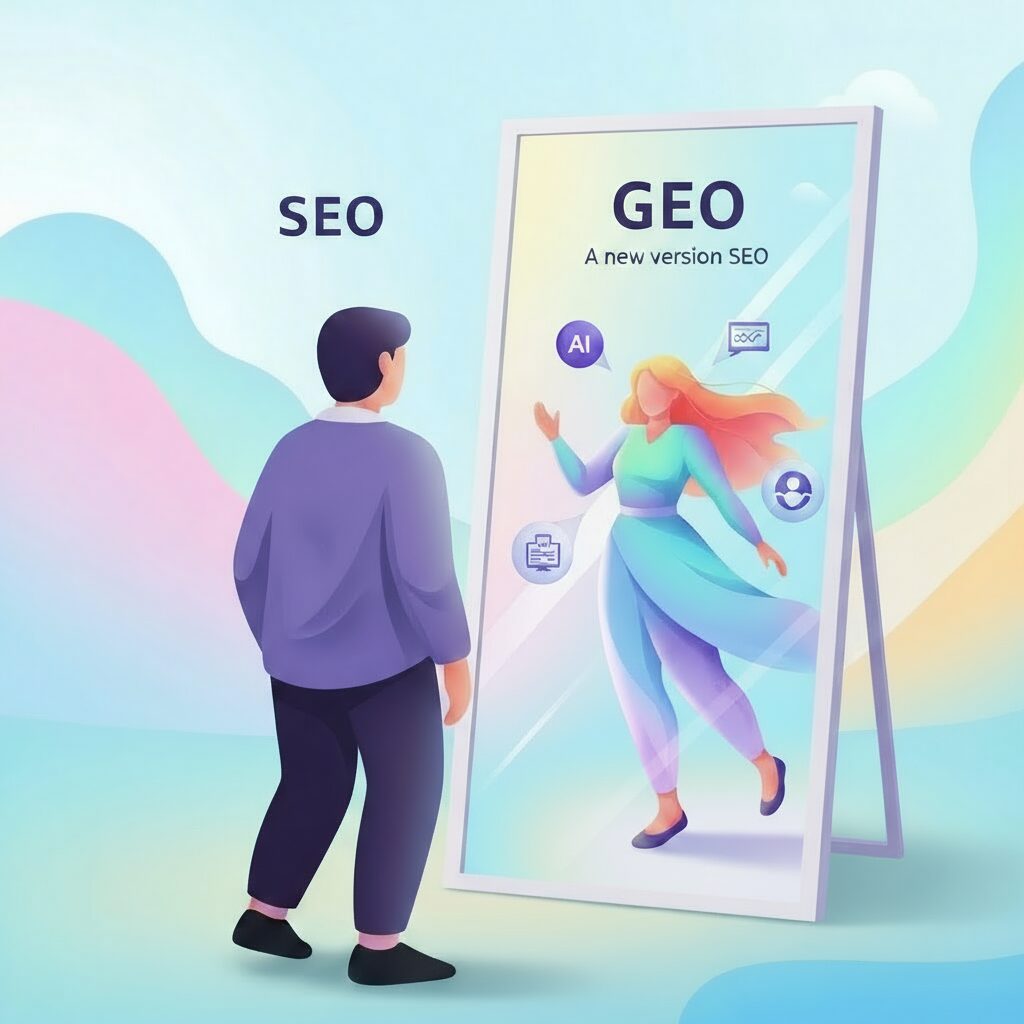
You’ve probably heard someone say, “SEO is dead.”
They’re wrong.
But here’s the part they get right:
SEO doesn’t look anything like it used to.
The tactics that once worked — keyword stuffing, backlinks, metadata hacks — are ghosts of a different internet.
Search has evolved.
Users have evolved.
And now, AI is the gatekeeper.
If you’re still playing by the old SEO rules, you’re optimizing for a world that doesn’t exist anymore.
The Old Playbook Is Obsolete
Let’s rewind.
Old SEO was about:
- Gaming the algorithm
- Reverse-engineering what Google wanted
- Chasing keyword rankings
- Winning clicks from blue links
It rewarded those who could manipulate the system — not necessarily those who served users best.
But then something shifted…
- Google got smarter.
- Users got lazier (or busier).
- Voice search grew.
- AI exploded.
And suddenly, nobody wants to click links anymore.
They want answers.
Right now.
In plain language.
Delivered by the machine they trust the most.
SEO Has Transformed into GEO
What replaced traditional SEO?
We call it GEO — Generative Engine Optimization.
Instead of optimizing for search engine crawlers, GEO is about optimizing for language models.
That means:
- Structuring your content in conversational Q&A formats
- Feeding the AI systems the right inputs
- Showing up as a trustworthy authority in context-rich dialogue
- Embedding your brand voice directly into the tools that answer questions
You’re no longer fighting for a spot on page 1.
You’re fighting to be the answer.
You Don’t Rank. You Get Recommended.
That’s the biggest shift:
Google = Rankings
AI = Recommendations
Rankings are objective. Recommendations are personal.
ChatGPT, Gemini, Claude — they don’t spit out a list of links.
They give opinions based on what they’ve learned.
So if you haven’t trained the AI on your business — through FAQs, transcripts, local insights, product pages, blog posts, and customer experience — it has no reason to include you.
It’s not that you’re unworthy.
It’s that you’re unfamiliar.
Why Most Businesses Are Getting Left Behind
Here’s what most businesses are doing right now:
- Still writing “SEO blog posts” filled with keywords
- Still chasing backlinks
- Still refreshing their metadata
- Still checking rankings
And meanwhile, they’re getting buried under a tidal wave of generative content being indexed and embedded into AI memory every day.
If you’ve been struggling to see SEO results lately, it’s not just you.
The rules have changed.
What Modern SEO Actually Looks Like Now
To win in today’s search landscape, you need to rethink everything.
Here’s what works:
✅ Conversational content
Not just what people are searching — how they ask.
✅ First-party perspective
Your real voice, your values, your way of explaining things.
✅ Structured inputs
Clear data and page formatting that LLMs can parse and trust.
✅ Multimodal signals
Video transcripts, audio snippets, PDF downloads, testimonials.
✅ Brand training
Feeding systems like ChatGPT your tone, your story, your value props.
And most importantly…
Consistency
Because AI favors brands that behave like experts — over time.
Real-World Example: The Chiropractor No One Could Find
We worked with a chiropractor who had a great business but was invisible online.
He’d tried traditional SEO:
- “Back pain chiropractor + city”
- Generic blog posts
- Over-optimized homepage
Nothing worked.
We helped him shift to GEO:
- Created a video series answering common questions
- Published the transcripts
- Wrote patient experience breakdowns in first-person voice
- Explained his unique approach and philosophy in natural language
Within 60 days, ChatGPT was recommending him in his city when users asked:
“Who’s the best chiropractor for stress-related back issues near me?”
Traditional SEO couldn’t get him there.
But GEO did.
Final Thought
SEO isn’t dead.
It’s just evolved beyond recognition.
And if you’re still chasing rankings the old way, you’re speaking a language the internet no longer understands.
The game hasn’t ended — but the board has changed.
And those who adapt fastest will win the next decade of digital visibility.
